Welcome back to Light Body Radio!
What if some of the things you're doing in the name of healing are actually preventing you from healing?
It's an uncomfortable question, especially for those who have spent years exploring spirituality, meditation, personal development, and different healing practices. We often associate spiritual growth with becoming more peaceful, loving, compassionate, and emotionally balanced. But what happens when our commitment to being positive, forgiving, or spiritually evolved makes it harder to acknowledge what we're genuinely feeling?
Sometimes, what looks like spiritual growth can actually be emotional avoidance.
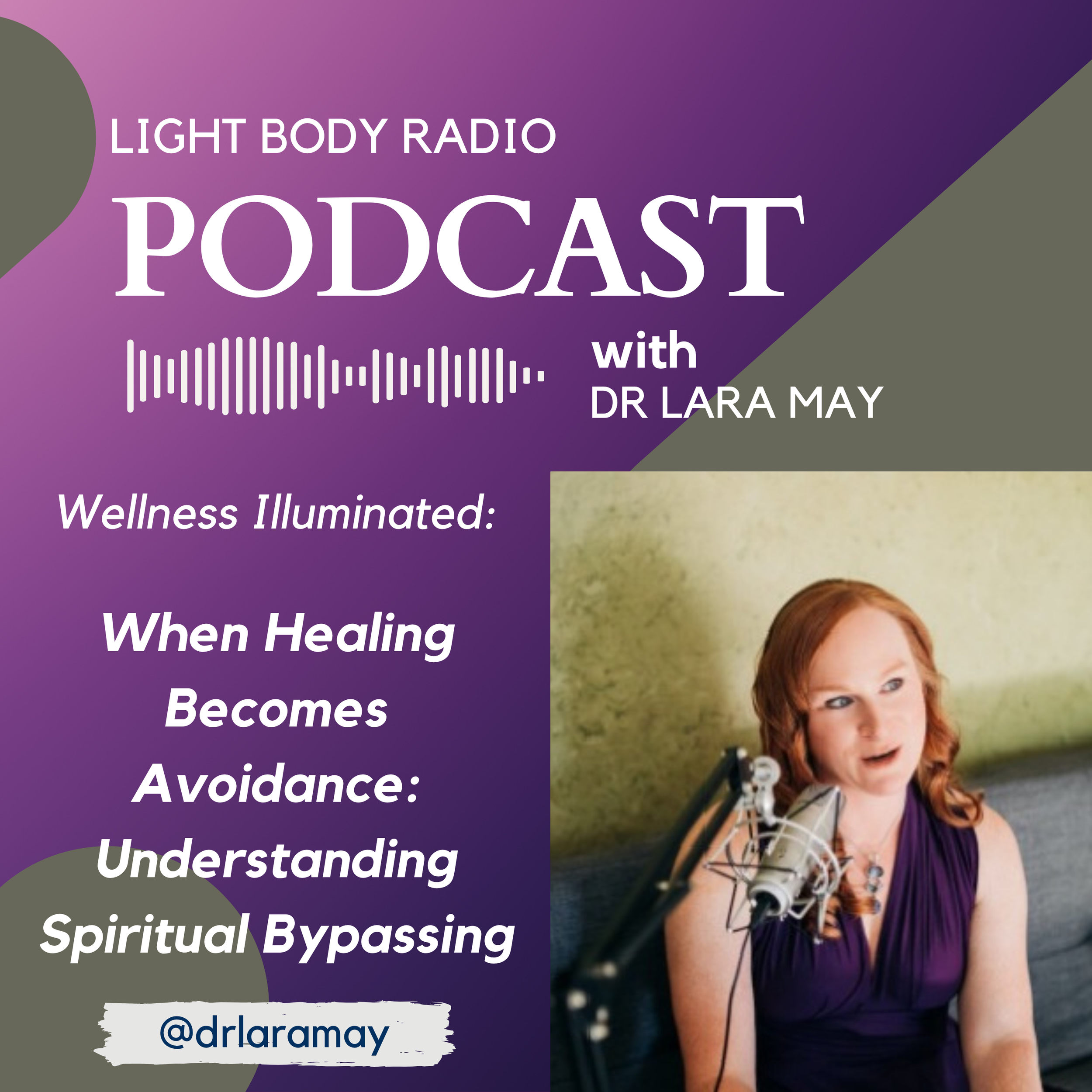
In this episode of Light Body Radio: Wellness Illuminated, Dr. Lara May explores Spiritual Bypassing, a concept that invites us to examine how we use spirituality in our everyday lives and whether our practices are helping us process our experiences or simply helping us avoid them.
What Is Spiritual Bypassing?
The term spiritual bypassing was introduced by psychologist John Welwood in the 1980s. It describes the tendency to use spiritual beliefs and practices to avoid unresolved emotional issues, psychological wounds, and developmental challenges.
Rather than acknowledging and working through difficult experiences, we may attempt to rise above them using spiritual concepts.
For example:
Instead of acknowledging anger, we tell ourselves we should operate only from love.
Instead of allowing ourselves to grieve, we insist that everything happens for a reason.
Instead of addressing unhealthy relationships, we convince ourselves that everyone is simply playing a role in our soul's evolution.
Instead of establishing boundaries, we interpret unconditional love as accepting every behavior.
These beliefs aren't necessarily harmful on their own. Finding meaning in painful experiences, practicing forgiveness, and choosing love can all be meaningful parts of personal growth.
The problem begins when we use these ideas to dismiss our emotions, ignore our needs, or avoid addressing situations that require our attention.
There is a difference between finding meaning in pain and using that meaning to avoid experiencing the pain. There is also a difference between forgiveness and pretending we were never hurt.
You can love someone deeply without giving them unlimited access to your life. You can understand someone's wounds without allowing yourself to be repeatedly hurt by their behavior.
When the Spiritual Ego Gets in the Way of Healing
When we think about the ego, we often associate it with arrogance, selfishness, or the need to be right. But the ego can also become attached to our spiritual identity.
We may begin to see ourselves as awakened, intuitive, compassionate, conscious, or spiritually evolved. Over time, we can become so invested in maintaining that identity that uncomfortable emotions start to feel like threats to who we believe we are.
We might think:
"I shouldn't feel angry. I've already done so much inner work."
"I've already healed that wound. I don't need to revisit it."
"I don't engage with negativity."
"If I'm truly evolved, I should always respond with love."
But difficult emotions don't disappear simply because we've developed a spiritual practice or gained greater self-awareness.
Anger, jealousy, resentment, insecurity, and fear are part of the human experience. Their presence doesn't automatically mean we've failed at healing or lost our spiritual connection.
In fact, our attachment to being healed can sometimes become an obstacle to healing itself.
The goal isn't to become someone who never experiences difficult emotions. It's to become someone who can acknowledge those emotions, understand what they may be communicating, and respond consciously rather than automatically.
The Problem With Toxic Positivity and Always Being High Vibration
Another common form of spiritual bypassing is the pressure to remain positive all the time.
In some spiritual communities, there is an emphasis on staying high vibration, focusing only on love and light, and avoiding negative thoughts out of fear that they will attract negative experiences.
While our thoughts can influence our perceptions, behaviors, and experiences, this doesn't mean every uncomfortable emotion is spiritually dangerous or that every negative thought will create a negative reality.
Consider someone grieving the loss of a loved one. Instead of being given space to experience their grief, they're told to focus on gratitude, remember that everything happens for a reason, or avoid lowering their vibration.
Even when these statements come from a place of good intentions, they can send an unintended message: that grief is something to overcome quickly or that experiencing sadness somehow reflects a lack of spiritual awareness.
This can become a form of emotional invalidation.
Grief isn't a spiritual failure. Anger isn't automatically evidence of low consciousness. Fear isn't something we must transcend every time it appears.
These emotions deserve acknowledgment, compassion, and space.
Being positive doesn't require denying what hurts. Gratitude doesn't mean we cannot grieve. And choosing love doesn't mean we have to ignore our own emotional needs.
Unconditional Love Does Not Mean Unconditional Access
One of the most important distinctions in spiritual growth is understanding the difference between unconditional love and unconditional access.
We can love someone while recognizing that their actions are unhealthy. We can have compassion for another person's experiences without taking responsibility for their behavior. We can forgive someone without continuing to place ourselves in situations that cause harm.
Healthy boundaries are not the opposite of love. They can be an expression of self-respect, emotional awareness, and personal responsibility.
Sometimes, spiritual beliefs about compassion, forgiveness, and acceptance can make it difficult to recognize when we are abandoning ourselves in the process of trying to understand others.
True compassion should include ourselves, too.
What Does Authentic Spiritual Growth Look Like?
Authentic spiritual growth isn't about appearing peaceful, remaining positive, or reaching a state where difficult emotions no longer exist.
It's about becoming more aware of our inner experiences and developing the capacity to meet them honestly.
It means allowing ourselves to feel anger without letting anger define our actions. It means grieving without judging ourselves for being sad. It means recognizing unhealthy patterns, establishing boundaries, and being willing to revisit parts of ourselves that still need attention.
Spirituality should help us become more present in our lives, not less connected to them.
We don't have to choose between spirituality and emotional honesty. We don't have to abandon meditation, energy healing, forgiveness, or positive thinking. Instead, we can examine how we use these practices and whether they support genuine emotional processing and personal growth.
The invitation is to move beyond the pressure to be perfectly healed and embrace the reality that we are all works in progress.
Healing Means Embracing the Whole Human Experience
Perhaps one of the most important shifts we can make on our healing journey is to stop treating uncomfortable emotions as evidence that we're doing something wrong.
You can be spiritual and still feel angry. You can be grateful and still experience grief. You can practice unconditional love and still establish firm boundaries. You can be deeply committed to personal growth and still have wounds that need attention.
These experiences don't make you less conscious or less evolved. They make you human.
As Dr. Lara explores in this episode, spiritual awakening isn't about escaping the human experience. It's about becoming conscious enough to participate in it fully.
So, the next time you find yourself trying to rise above an uncomfortable emotion, consider asking yourself: Am I truly processing this experience, or am I using spirituality to avoid it?
Sometimes, the most meaningful step toward healing isn't finding a higher vibration or another spiritual practice. It's allowing yourself to be honest about what you're feeling and giving that experience the attention it deserves.
True healing doesn't ask us to escape our humanity. It invites us to embrace it.
Listen to this episode of Light Body Radio: Wellness Illuminated with Dr. Lara May and explore how to move beyond spiritual bypassing toward a more authentic, integrated expression of spirituality.
About Dr. Lara May:

DR. LARA MAY
is an Advanced Practice Clinical Pharmacist who specializes in getting to the root cause of disease via functional medicine. Due to her struggle with her own health, Lara started studying & practicing functional medicine in 2017.
Dr. Lara’s passion & mission is to empower patients to take an active role in their health, so that they can create their health on their terms. It was during the COVID pandemic that Lara decided to focus on helping type 2 diabetics understand and reverse their disease, after she witnessed the increased death rates as a consequence of diabetes as a comorbidity.
Type 2 diabetes is completely preventable and reversible, yet its numbers are growing every year.
Dr. Lara believes that if patients are given the tools and knowledge they will make the right decisions for their health.
Contact Dr. Lara:
Email: laramay@drlaramay.com
Podcast Website: https://drlaramay.podbean.com/
Website: https://drlaramay.com
Social media: @drlaramay on IG, FB & Twitter
YouTube: https://www.youtube.com/@drlaramay
Tiktok: @drlaramayfxnmed
Spotify: @LightBodyRadio
Apple Podcasts: @LightBodyRadio
Don't forget to rate and review Light Body Radio
→
Other ways to listen to today’s episode:
There is lots more on the way!
Don't miss it!
Namaste,

Subscribe
Join and receive exclusive tools, tips, and resources directly from Dr. Lara, plus a FREE copy of the Health Gut Guide!!
Find More Episodes
- 2024 3
- 2024 achievements 2
- 2024 grateful 2
- 2024 reflections 2
- 2025 1
- 4 step approach to gut health 2
- 4th chakra 1
- 90-days goal 1
- ALCAT testing for food intolerances 1
- Accomplist 1
- Adora Winquist 2
- Alie Harwood 1
- Anita Kaiser 1
- Autumn 6
- Ayahuasquera 1
- BPC-157 4
- Blending science 1
- Boosting Immunity 1
- Brain health 5
- C60 2
- COVID-19 5
- Catherine Laub 2
- Creatine 1
- DSIP 3
- David Krantz 4
- David greenwalt 1
- Delta Sleep-Inducing Peptide 3
- Dr Melissa MacDonald 1
- Dr Shawna Jamieson 2
- Dr. Jo Anne WhiteDr Jo Anne WhiteJo Anne White PhDJo Anne WhitePower Your LifePower Your Life RadioDr. JoAnne WhiteJoanne white#poweryourlife#jwpoweryourlifePower Your Life Talk RadioPower Your Life Talk Radio ShowIntegrative Nutrition Health CoachIINHealth CoachDr. Lara MayLara MaLara Mayenergy medicineintuitive healingintegrative nutrition 1
- Dr. Lara May 280
- EFT 1
- ESS60 2
- Emma Foster 1
- Empowering women to take an active role in their health & healing 12
- Energy Healer 5
- Energy Medicine 8
- Equinox 6
- Fall Detox 6
- Fall Season 6
- Faultline and reasons 4
- Functional Medicine 17
- GLP-1 5
- GLP-1 Peptides 5
- Getting Real About the Potential & Drawbacks of Psychedelics In Mental Health Treatment 1
- Gretta Chamberlain 2
- Healing 13
- Healthy journey 1
- Holistic Nutritionist 5
- Hormonal Imbalance 9

Hi, I'm Lara!
(pronounced like Sarah, but with a L)
Are you ready to lose weight, reduce stress, and reinvigorate your life?! Together let’s uncover your motivators for change, and turn your vision for your vibrant future into your new reality.
Come say hi on Instagram