
Welcome back to Light Body Radio!
What if researchers could influence how the body stores and uses fat by targeting a specific enzyme involved in cellular metabolism?
It's an intriguing possibility, and it's one reason 5-Amino-1MQ has been attracting attention in conversations about fat loss, NAD+ metabolism, and emerging approaches to metabolic health.
You may have encountered 5-Amino-1MQ on social media or heard it discussed alongside peptides and other compounds marketed for body composition. Some claims suggest it can support fat loss without requiring people to eat less. Others connect it to NAD+, a molecule essential to cellular energy metabolism.
But what does the research actually show?
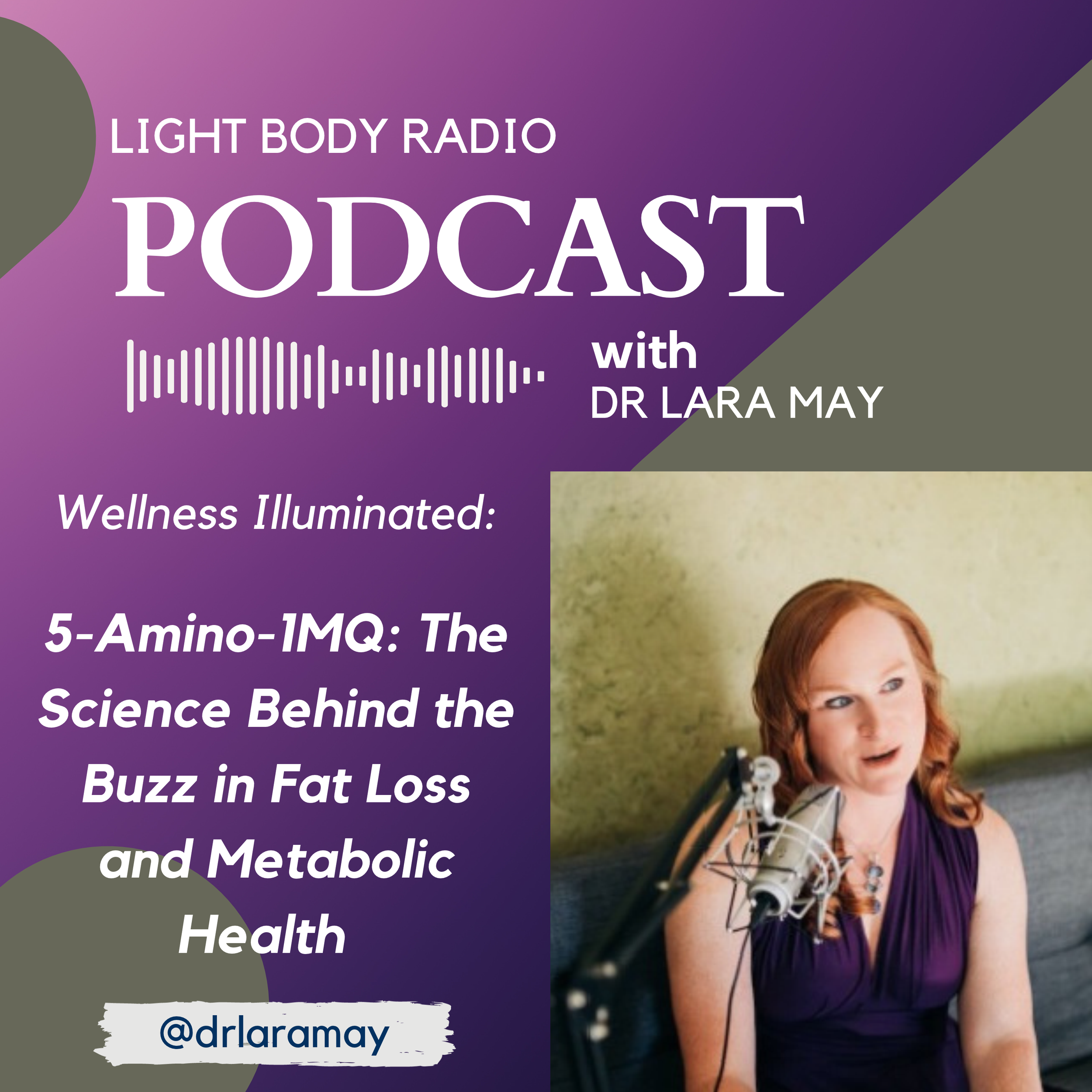
In this episode of Light Body Radio: Wellness Illuminated, Dr. Lara May explores the biochemistry behind 5-Amino-1MQ, the enzyme it targets, and the early research that has generated interest in its potential. More importantly, she examines the distinction between promising laboratory findings and evidence of real-world benefits in humans.
What Is 5-Amino-1MQ?
First, let's clear up a common misconception: 5-Amino-1MQ is not technically a peptide.
It is a small-molecule compound that has been studied for its ability to inhibit an enzyme called nicotinamide N-methyltransferase (NNMT).
NNMT is involved in the metabolism of nicotinamide, a form of vitamin B3 and a precursor in NAD+ metabolism. NAD+ (nicotinamide adenine dinucleotide) is an essential coenzyme involved in numerous cellular processes, including energy production and metabolic regulation.
Because NNMT participates in pathways connected to nicotinamide metabolism, researchers have become interested in understanding how altering its activity might influence cellular metabolism.
This is where 5-Amino-1MQ enters the conversation.
By inhibiting NNMT, 5-Amino-1MQ provides researchers with a way to investigate what happens when this particular enzyme's activity is reduced. The potential implications for fat tissue and metabolic function are what make the compound especially interesting.
However, understanding a biological mechanism is only the first step. It does not automatically mean a compound will produce a meaningful health benefit in people.
Why Is NNMT Interesting in Fat Metabolism?
Fat tissue is much more than a place where the body stores excess energy.
Adipose tissue is metabolically active. It participates in hormone signaling, energy regulation, inflammation, and communication with other tissues throughout the body.
Researchers are interested in NNMT because of its involvement in cellular metabolic pathways and its potential influence on how fat tissue functions.
If researchers can alter a pathway that contributes to metabolic activity in fat cells, could that eventually lead to new ways of understanding or addressing metabolic dysfunction?
That's the scientific question behind much of the interest in NNMT inhibition.
It is also important to understand that the relationship between NNMT, NAD+ metabolism, and fat loss is more complex than a simple claim that inhibiting one enzyme automatically increases NAD+ or causes weight loss.
The actual effects depend on the biological context, the compound, and what is being measured.
What Did the Research on 5-Amino-1MQ Find?
One of the studies generating interest is the research by Neelakantan and colleagues, titled Selective and membrane-permeable small molecule inhibitors of nicotinamide N-methyltransferase reverse high fat diet-induced obesity in mice, published in Biochemical Pharmacology.
The researchers investigated small-molecule NNMT inhibitors, including 5-Amino-1MQ, using cell-based experiments and a mouse model of diet-induced obesity.
The study reported changes associated with NNMT inhibition and examined its effects on fat-related outcomes in mice. The animal experiment included an 11-day treatment period.
These findings helped generate interest in NNMT as a possible target for metabolic research.
But there is an important distinction: a result observed in mice is not proof that the same result will occur in humans.
Animal studies help researchers investigate biological mechanisms, explore potential effects, and determine what questions deserve further investigation. They cannot establish that a compound is safe or effective as a human weight-loss intervention.
What About Combining NNMT Inhibition With Calorie Reduction?
A follow-up mouse study, Reduced calorie diet combined with NNMT inhibition establishes a distinct microbiome in DIO mice, explored another interesting aspect of this research.
Rather than looking at NNMT inhibition in isolation, the researchers examined how it interacted with dietary changes in mice with diet-induced obesity.
The study investigated the effects of a reduced-calorie diet, NNMT inhibition, and their combination, including changes in the gut microbiome.
This adds another layer to the discussion because metabolic health is not controlled by a single pathway. Diet, cellular metabolism, gut microbial communities, and other biological systems interact in complex ways.
The findings provide additional research questions worth exploring. However, they do not establish that combining calorie restriction with 5-Amino-1MQ produces the same outcomes in humans.
From Mouse Studies to Social Media Claims
As compounds become popular online, scientific findings can sometimes get simplified into claims that sound much more definitive than the original research.
A study involving mice becomes a statement about human weight loss. A proposed biochemical mechanism becomes a guaranteed outcome. A compound that is being investigated becomes something people assume is already clinically established.
This is why it is important to examine the evidence behind the claims.
When evaluating a compound like 5-Amino-1MQ, consider three essential questions:
1. Is the biology plausible?
Does the compound interact with a biological pathway that could reasonably influence the outcome being discussed?
2. Did the compound produce a measurable effect in research?
What was actually measured? Was the study conducted in cells, animals, or humans? What were the limitations?
3. Do we know that it benefits people?
Have human clinical trials established its safety, effectiveness, appropriate dosing, and potential risks?
These questions help separate scientific possibility from established clinical evidence.
For 5-Amino-1MQ, the early findings are interesting, but the animal research discussed here does not establish human weight-loss benefits. Human clinical evidence is needed before making confident conclusions about its role in metabolic health.
What We Still Need to Learn About 5-Amino-1MQ
There is a great deal researchers would need to understand before 5-Amino-1MQ could be considered an established approach to human metabolic health.
Important questions include:
Does NNMT inhibition produce similar metabolic effects in humans?
What happens to NAD+ and related metabolic pathways when NNMT activity is altered?
What are the potential short-term and long-term effects?
What dosing and delivery approaches, if any, are appropriate?
Are there potential interactions, adverse effects, or safety concerns?
How might individual metabolic differences influence responses?
These are not minor details. They are essential parts of evaluating whether an emerging compound has a meaningful place in clinical practice.
The fact that a compound is available or being discussed online does not mean its safety and effectiveness have been established.
Looking Beyond the Hype: Following the Science
Emerging metabolic research is exciting because it helps us understand how interconnected the body's biological systems really are.
5-Amino-1MQ offers an interesting opportunity to explore NNMT, nicotinamide metabolism, fat tissue, and the broader pathways involved in metabolic health.
But curiosity should always be accompanied by critical thinking.
We don't need to dismiss early research simply because it is preliminary. At the same time, we shouldn't turn promising animal findings into human health promises before the evidence supports them.
As Dr. Lara emphasizes, the goal is to understand what has been studied, what has been measured, what the findings suggest, and what still needs investigation.
Because promising science deserves curiosity, but responsible health decisions require evidence.
Listen to this episode of LightBody Radio: Wellness Illuminated with Dr. Lara May for a closer look at 5-Amino-1MQ, NNMT inhibition, and the science behind the growing interest in emerging metabolic compounds.
Educational note: This discussion is for informational purposes and is not a recommendation to use 5-Amino-1MQ. The research discussed includes laboratory and animal studies, which do not establish safety or effectiveness in humans. Consult a qualified healthcare professional before considering any investigational or unapproved compound.
About Dr. Lara May:

DR. LARA MAY
is an Advanced Practice Clinical Pharmacist who specializes in getting to the root cause of disease via functional medicine. Due to her struggle with her own health, Lara started studying & practicing functional medicine in 2017.
Dr. Lara’s passion & mission is to empower patients to take an active role in their health, so that they can create their health on their terms. It was during the COVID pandemic that Lara decided to focus on helping type 2 diabetics understand and reverse their disease, after she witnessed the increased death rates as a consequence of diabetes as a comorbidity.
Type 2 diabetes is completely preventable and reversible, yet its numbers are growing every year.
Dr. Lara believes that if patients are given the tools and knowledge they will make the right decisions for their health.
Contact Dr. Lara:
Email: laramay@drlaramay.com
Podcast Website: https://drlaramay.podbean.com/
Website: https://drlaramay.com
Social media: @drlaramay on IG, FB & Twitter
YouTube: https://www.youtube.com/@drlaramay
Tiktok: @drlaramayfxnmed
Spotify: @LightBodyRadio
Apple Podcasts: @LightBodyRadio
Don't forget to rate and review Light Body Radio
→
Other ways to listen to today’s episode:
There is lots more on the way!
Don't miss it!
Namaste,

Subscribe
Join and receive exclusive tools, tips, and resources directly from Dr. Lara, plus a FREE copy of the Health Gut Guide!!
Find More Episodes
- 1MQ 1
- 2024 3
- 2024 achievements 2
- 2024 grateful 2
- 2024 reflections 2
- 2025 1
- 4 step approach to gut health 2
- 4th chakra 1
- 5-Amino 1MQ 1
- 90-days goal 1
- ALCAT testing for food intolerances 1
- Accomplist 1
- Adora Winquist 2
- Alie Harwood 1
- Anita Kaiser 1
- Autumn 6
- Ayahuasquera 1
- BPC-157 4
- Blending science 1
- Boosting Immunity 1
- Brain health 5
- C60 2
- COVID-19 5
- Catherine Laub 2
- Creatine 1
- DSIP 3
- David Krantz 4
- David greenwalt 1
- Delta Sleep-Inducing Peptide 3
- Dr Melissa MacDonald 1
- Dr Shawna Jamieson 2
- Dr. Jo Anne WhiteDr Jo Anne WhiteJo Anne White PhDJo Anne WhitePower Your LifePower Your Life RadioDr. JoAnne WhiteJoanne white#poweryourlife#jwpoweryourlifePower Your Life Talk RadioPower Your Life Talk Radio ShowIntegrative Nutrition Health CoachIINHealth CoachDr. Lara MayLara MaLara Mayenergy medicineintuitive healingintegrative nutrition 1
- Dr. Lara May 282
- EFT 1
- ESS60 2
- Emma Foster 1
- Empowering women to take an active role in their health & healing 13
- Energy Healer 6
- Energy Medicine 9
- Equinox 6
- Fall Detox 6
- Fall Season 6
- Faultline and reasons 4
- Functional Medicine 17
- GLP-1 5
- GLP-1 Peptides 5
- Getting Real About the Potential & Drawbacks of Psychedelics In Mental Health Treatment 1
- Gretta Chamberlain 2
- Healing 14
- Healthy journey 1

Hi, I'm Lara!
(pronounced like Sarah, but with a L)
Are you ready to lose weight, reduce stress, and reinvigorate your life?! Together let’s uncover your motivators for change, and turn your vision for your vibrant future into your new reality.
Come say hi on Instagram