The Power of Neuroplasticity: Transforming Your Brain, Mind, and Life with Dr. Patrick Porter
Welcome back to Light Body Radio!
Your brain is not static. It is constantly adapting to your experiences, environment, thoughts, behaviors, and habits. This remarkable ability to change is known as neuroplasticity—and it may be one of the most important concepts for understanding brain health and cognitive wellness.
For decades, researchers have explored how the brain learns, adapts, creates new connections, and responds to repeated experiences. Today, neuroplasticity has become an increasingly important concept in conversations about mental performance, emotional resilience, healthy aging, stress management, and overall brain health.
But what does neuroplasticity actually mean? And can we intentionally influence the way our brains function?
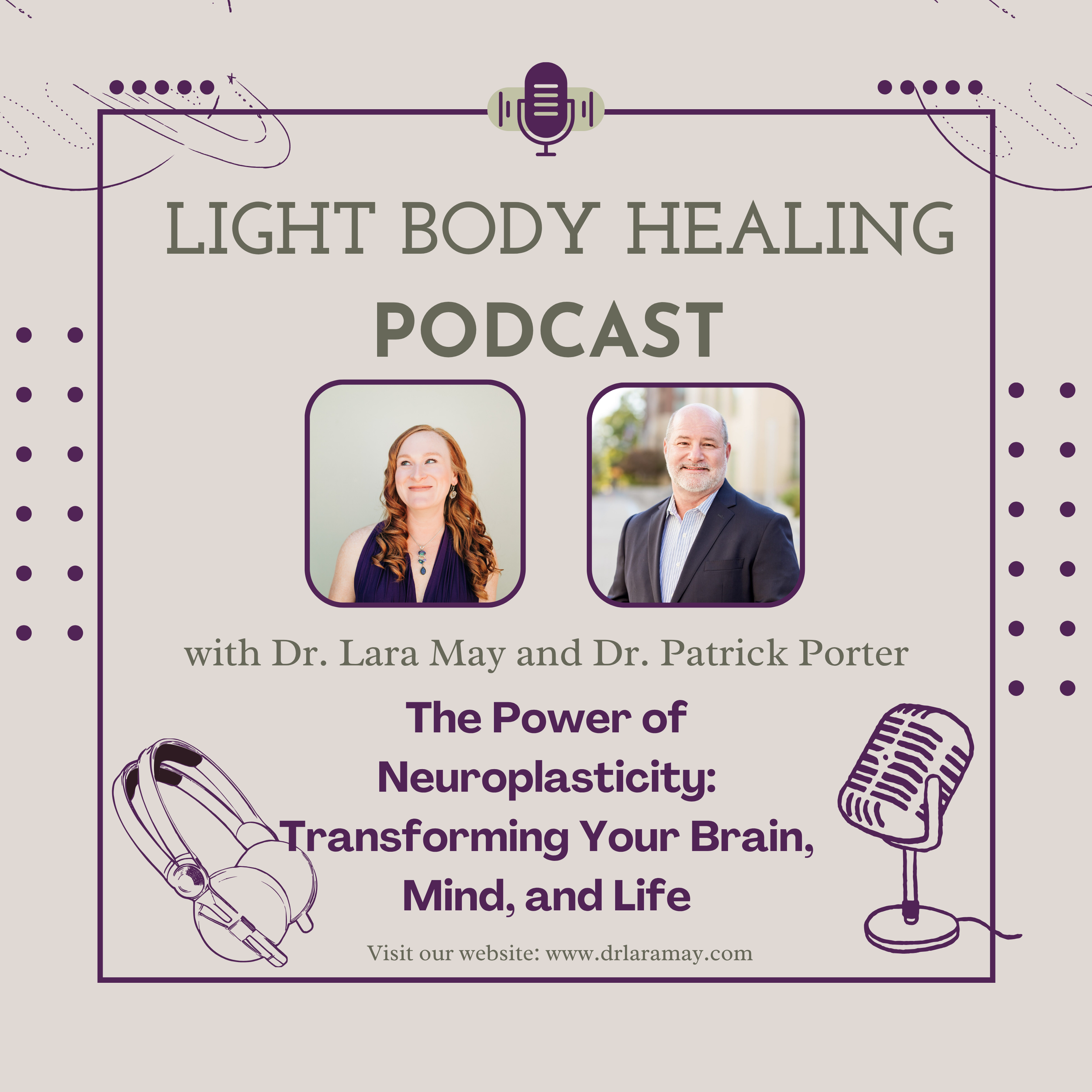
In this episode of Light Body Radio, Dr. Lara May explores these questions with Dr. Patrick Porter, an award-winning author, speaker, educator, and pioneer in brainwave entrainment technology.
Their conversation explores the fascinating relationship between neuroplasticity, mindset, meditation, brainwave states, relaxation, and holistic brain fitness.
What Is Neuroplasticity?
Neuroplasticity refers to the brain's ability to change and adapt throughout life.
Rather than functioning like a fixed machine, the brain continuously responds to experiences and information. Neural connections can strengthen, weaken, reorganize, and form in response to learning and repeated patterns.
This means our experiences and behaviors matter.
The activities we practice repeatedly can influence the patterns our brains become accustomed to.
That doesn't mean we can simply "think" our way out of every challenge. However, it does highlight the incredible adaptability of the human nervous system and the importance of the habits, environments, and experiences we repeatedly expose ourselves to.
Can You Train Your Brain?
One of the central questions explored in this episode is whether we can intentionally support the brain's ability to adapt.
Dr. Patrick Porter's work has focused extensively on technologies and practices designed to influence brainwave states, including brainwave entrainment.
Brainwave entrainment is based on the concept that rhythmic sensory stimulation can influence patterns of brain activity. Audio-based approaches may use specific tones, rhythms, or frequencies designed to encourage particular states such as relaxation or focused attention.
The field continues to be researched, and different forms of brainwave-based interventions have varying levels of evidence depending on the application.
For listeners interested in brain health, this raises an important question:
How can we create environments and daily practices that support the brain's natural capacity to adapt?
The Mindset Connection
Dr. Porter's personal story provides an interesting perspective on this question.
As a young teenager, he was introduced to meditation and relaxation techniques through his father's experience with recovery. He became fascinated by the possibility that changing mental and physiological states could influence behavior and overall well-being.
He began experimenting with affirmations and mental practices himself.
According to Dr. Porter, this period became a significant turning point in his life, influencing his academic performance, mindset, and future career.
That early experience eventually led him toward psychology, technology, and decades of work exploring how the brain responds to different forms of stimulation.
His story illustrates an important principle:
What we repeatedly practice can become part of how we function.
Whether that practice involves meditation, physical exercise, learning, relaxation, focused attention, or another intentional behavior, repetition is an important part of developing and reinforcing patterns.
What Is Brainwave Entrainment?
Another major topic in this episode is brainwave entrainment technology.
The brain produces electrical activity that can be measured in different frequency ranges. These patterns are commonly associated with different states of consciousness, attention, relaxation, and sleep.
Brainwave entrainment technologies attempt to use rhythmic sensory input—such as auditory stimulation—to encourage particular patterns of brain activity.
While the science is still developing and research findings vary by technique and application, the concept has generated considerable interest in neuroscience, wellness, meditation, and cognitive performance.
Dr. Porter has spent decades developing and studying technologies designed to support relaxation and brain fitness.
The broader conversation raises an interesting possibility: rather than viewing brain health as something we only address when problems arise, could we approach it as an ongoing part of our overall wellness?
Brain Fitness Is More Than Mental Puzzles
When people hear the phrase brain fitness, they may immediately think about crossword puzzles, memory games, or apps designed to challenge cognitive skills.
But Dr. Porter's approach takes a much broader view.
Brain health doesn't exist in isolation from the rest of the body.
Our mental and cognitive well-being is influenced by many aspects of our lives, including:
Sleep
Stress
Physical activity
Nutrition
Emotional health
Social connection
Relaxation
Purpose and meaning
Learning and mental stimulation
Overall lifestyle
This holistic perspective is particularly relevant to the broader conversation around healthy aging.
Taking care of the brain isn't simply about trying to become smarter. It's also about creating the conditions that allow the brain and nervous system to function optimally.
The Circle of Vitality
Dr. Porter also discusses his holistic model of wellness, which looks at multiple dimensions of life rather than focusing exclusively on cognitive performance.
This is an important shift in perspective.
Your brain doesn't exist separately from your physical body, emotional experiences, relationships, environment, or sense of purpose.
When one area of life becomes chronically disrupted, it can affect other areas as well.
This is why a comprehensive approach to wellness can be valuable when thinking about long-term brain health.
Instead of asking only:
"How can I improve my memory?"
we can begin asking:
"What kind of lifestyle supports my brain, body, emotions, and overall well-being?"
Neuroplasticity and Healthy Aging
Neuroplasticity is especially interesting when we consider cognitive longevity.
Aging is a natural biological process, but getting older does not mean that learning and adaptation suddenly stop.
The brain retains the ability to learn throughout life.
Continuing to learn new skills, challenge yourself intellectually, stay physically active, maintain meaningful relationships, manage stress, and prioritize restorative sleep are all important components of a brain-healthy lifestyle.
Emerging research continues to explore how lifestyle factors influence cognitive health across the lifespan.
This makes neuroplasticity a powerful framework for thinking about healthy aging—not because it promises to prevent every aspect of cognitive decline, but because it reminds us that the brain remains dynamic.
Your Daily Habits Matter
One of the most practical takeaways from this conversation is that brain health isn't necessarily created through one dramatic intervention.
It is shaped by what we repeatedly do.
Consider your everyday patterns:
How do you start your morning?
How much time do you spend moving your body?
Are you giving your nervous system opportunities to relax?
Are you constantly multitasking and consuming information, or do you create periods of focused attention?
Are you learning something new?
How well are you sleeping?
Are you maintaining meaningful relationships?
These seemingly ordinary behaviors can become part of the environment in which your brain operates every day.
The Brain, Stress, and Emotional Resilience
Brain health isn't only about cognitive performance.
The ability to regulate stress and recover from challenging experiences is also an important part of overall well-being.
Chronic stress can influence multiple physiological systems, including those involved in sleep, mood, cognition, and nervous system regulation.
This is why practices that encourage relaxation and recovery—such as meditation, breathwork, movement, adequate sleep, and other evidence-informed stress-management strategies—can be valuable components of a comprehensive approach to wellness.
The goal isn't to eliminate stress completely.
Instead, it's about developing greater capacity to respond, recover, and adapt.
From Mindset to Brain Health
Dr. Porter's journey demonstrates how a personal fascination with meditation and mindset evolved into decades of work exploring the relationship between technology, psychology, and brain function.
His story also highlights how a change in perspective can become the beginning of a much larger transformation.
Neuroplasticity doesn't mean that every thought instantly rewires the brain.
It means that the brain has an extraordinary capacity for adaptation—and that repeated experiences and behaviors can contribute to that adaptation.
That gives us a reason to pay attention to the patterns we practice every day.
What You'll Discover in This Episode
In this episode of LightBody Radio, you'll learn more about:
What neuroplasticity means
How the brain adapts and changes
The relationship between mindset and brain function
Dr. Porter's personal introduction to meditation
The history of brainwave entrainment technology
What brainwave entrainment is designed to do
How meditation and relaxation may support well-being
Why brain fitness goes beyond memory games
The importance of holistic wellness for brain health
The connection between stress, relaxation, and cognitive wellness
How lifestyle choices can support healthy aging
Why continuing to learn and adapt matters throughout life
Transforming Your Brain, Mind, and Life
Your brain is one of the most adaptable systems in the human body.
Every day, we interact with experiences that shape how we think, feel, behave, and respond to the world around us.
The goal isn't to chase perfect brain performance.
It's to understand the brain well enough to create habits, environments, and practices that support clarity, resilience, adaptability, and long-term well-being.
Because when we understand neuroplasticity, we gain a different perspective on what is possible.
The brain can learn.
The brain can adapt.
And throughout our lives, there are opportunities to support that process.
About My Guest:

DR. PATRICK PORTER, PhD
is an award-winning author, speaker, and founder of BrainTap®, a leading neuroscience-based platform designed to help people achieve optimal brain health and performance. For over three decades, Dr. Porter has been at the forefront of brainwave entrainment technology, championing non-invasive, natural approaches to enhance mental clarity, emotional resilience, and cognitive longevity.
His latest book, Brain Fitness Blueprint (released October 21, 2025), synthesizes cutting-edge neuroscience, ancient wisdom, and practical lifestyle tools to redefine what it means to be brain fit in the modern world. Far beyond puzzles or mental exercises, the book introduces the Circle of Vitality—a holistic model covering eight dimensions of wellness, from physical and emotional to financial and spiritual. It explores the brain’s ability to adapt and thrive through neuroplasticity, balanced brainwave states, and deliberate lifestyle design.
Dr. Porter’s work is backed by over 30 clinical studies and is trusted by more than 120,000 users, including professional athletes, CEOs, and over 3,000 health and wellness clinics worldwide. His pioneering contributions have been featured in major outlets such as The Wall Street Journal, CNN, and The Joe Rogan Experience.
Through BrainTap and Brain Fitness Blueprint, Dr. Porter is leading a global movement to help people recover from stress, elevate performance, and reclaim their innate human potential—one brain at a time.
Contact Dr. Patrick:
Website (Dr. Porter): https://drpatrickporter.com/
Facebook (Dr. Porter): https://www.facebook.com/DrPatrickPorter/
Instagram (Dr. Porter): https://www.instagram.com/drpatrickporter/
LinkedIn (Dr. Porter): https://www.linkedin.com/in/drpatrickporter/
Website (Brain Tap): https://braintap.com
Facebook (BrainTap): https://www.facebook.com/braintaptech/
Instagram (BrainTap): https://www.instagram.com/braintaptech/
Order Brain Fitness Blueprint: https://brainfitnessblueprint.com
Don't forget to rate and review Light Body Radio
→
Other ways to listen to today’s episode:
There is lots more on the way!
Don't miss it!
Namaste,

Subscribe
Join and receive exclusive tools, tips, and resources directly from Dr. Lara, plus a FREE copy of the Health Gut Guide!!
Find More Episodes
- 2024 3
- 2024 achievements 2
- 2024 grateful 2
- 2024 reflections 2
- 2025 1
- 4 step approach to gut health 2
- 4th chakra 1
- 90-days goal 1
- ALCAT testing for food intolerances 1
- Accomplist 1
- Adora Winquist 2
- Alie Harwood 1
- Anita Kaiser 1
- Autumn 6
- Ayahuasquera 1
- BPC-157 4
- Blending science 1
- Boosting Immunity 1
- Brain health 5
- C60 2
- COVID-19 5
- Catherine Laub 2
- Creatine 1
- DSIP 3
- David Krantz 4
- David greenwalt 1
- Delta Sleep-Inducing Peptide 3
- Dr Melissa MacDonald 1
- Dr Shawna Jamieson 2
- Dr. Jo Anne WhiteDr Jo Anne WhiteJo Anne White PhDJo Anne WhitePower Your LifePower Your Life RadioDr. JoAnne WhiteJoanne white#poweryourlife#jwpoweryourlifePower Your Life Talk RadioPower Your Life Talk Radio ShowIntegrative Nutrition Health CoachIINHealth CoachDr. Lara MayLara MaLara Mayenergy medicineintuitive healingintegrative nutrition 1
- Dr. Lara May 276
- EFT 1
- ESS60 2
- Emma Foster 1
- Empowering women to take an active role in their health & healing 12
- Energy Healer 5
- Energy Medicine 8
- Equinox 6
- Fall Detox 6
- Fall Season 6
- Faultline and reasons 4
- Functional Medicine 17
- GLP-1 5
- GLP-1 Peptides 5
- Getting Real About the Potential & Drawbacks of Psychedelics In Mental Health Treatment 1
- Gretta Chamberlain 2
- Healing 13
- Healthy journey 1
- Holistic Nutritionist 5
- Hormonal Imbalance 9

Hi, I'm Lara!
(pronounced like Sarah, but with a L)
Are you ready to lose weight, reduce stress, and reinvigorate your life?! Together let’s uncover your motivators for change, and turn your vision for your vibrant future into your new reality.

Come say hi on Instagram